
v.2 MuA 15 bp Insertion Mutagenesis Kit
Kit Overview
The Domus v.2 MuA 15 bp Insertion Mutagenesis Kit builds on our original research demonstrating the use of MuA transposition for generating random, defined 15 bp insertions in target DNA (Poussu et al., 2004). The kit offers a simple and efficient method for applying this technology to cloned DNA.
Powered by the highly efficient hyperactive v.2 MuA transposase, the system enables the construction of diverse insertion libraries from a single target DNA.
When an insertion occurs within a protein-coding region, the final 15 bp sequence maintains the reading frame and introduces five additional amino acids without deleting or substituting the original amino acids. Importantly, the inserted sequence is designed so that no stop codon is introduced by the 15 bp insertion.
Random insertion • 5-amino-acid insertion • Reading frame maintained • No stop codon introduced • MuA transposase -based technology
| Domus v.2 MuA 15 bp Insertion Mutagenesis Kit |
|---|
|
Includes:
Price: 320 € (VAT 0%) |
Applications
The v.2 MuA 15 bp Insertion Mutagenesis Kit can be used for:
Protein Engineering and Functional Mapping
Generate diverse libraries of random five-amino-acid insertions throughout protein-coding sequences to map functional domains, identify insertion-tolerant regions, and discover variants with altered activity, stability, specificity, or regulation.
Promoter and Regulatory-Region Mutagenesis
Introduce short insertions throughout cloned non-coding DNA to identify regions important for gene regulation.
Viral Genome Mutagenesis
Generate random 15 bp insertions throughout cloned viral genomes to identify functionally important regions and insertion-tolerant sites in viral proteins. Tolerated positions can provide starting points for downstream viral genome and protein engineering, including the introduction of functional domains, tags, reporters, or other sequences.
Random NotI Site Insertion
Conveniently introduce a NotI restriction site into large DNA constructs, including plasmids, cosmids, PACs, BACs, and DNA virus genomes, for straightforward downstream molecular biology applications.
Explore Protein Function with Insertion Mutagenesis
Traditional point mutagenesis reveals the importance of individual amino acid residues. Insertion mutagenesis provides a complementary approach by introducing short sequence perturbations throughout a protein.
A library of five-amino-acid insertions can help identify regions that:
- tolerate structural modification
- are essential for protein activity
- influence protein stability or folding, with five-amino-acid insertions generating temperature-sensitive mutants at a high frequency
- participate in protein–protein interactions
- affect substrate recognition or specificity
- control localization or regulation
The same strategy can also be applied to promoters and other regulatory DNA sequences to identify functionally important regions.
How It Works
The system combines MuA-mediated in vitro transposition with restriction digestion and re-ligation.
- Random MuA Transposition
MuA transposase inserts a selectable transposon into random positions within the target plasmid. - Select the Insertion Library
Following transformation, antibiotic selection enables recovery of plasmids containing transposon insertions. - Remove the Transposon
The inserted transposon is removed by NotI digestion, leaving defined sequences at the insertion site. - Re-ligate the Target DNA
Self-ligation of the digested plasmid generates a final 15 bp insertion at the original MuA integration site. - Screen Your Library
The resulting insertion library can be selected or screened for the phenotype or a molecular function of interest. Various next generation DNA sequencing protocols can be used to compile the sequences of the selected mutant clones.
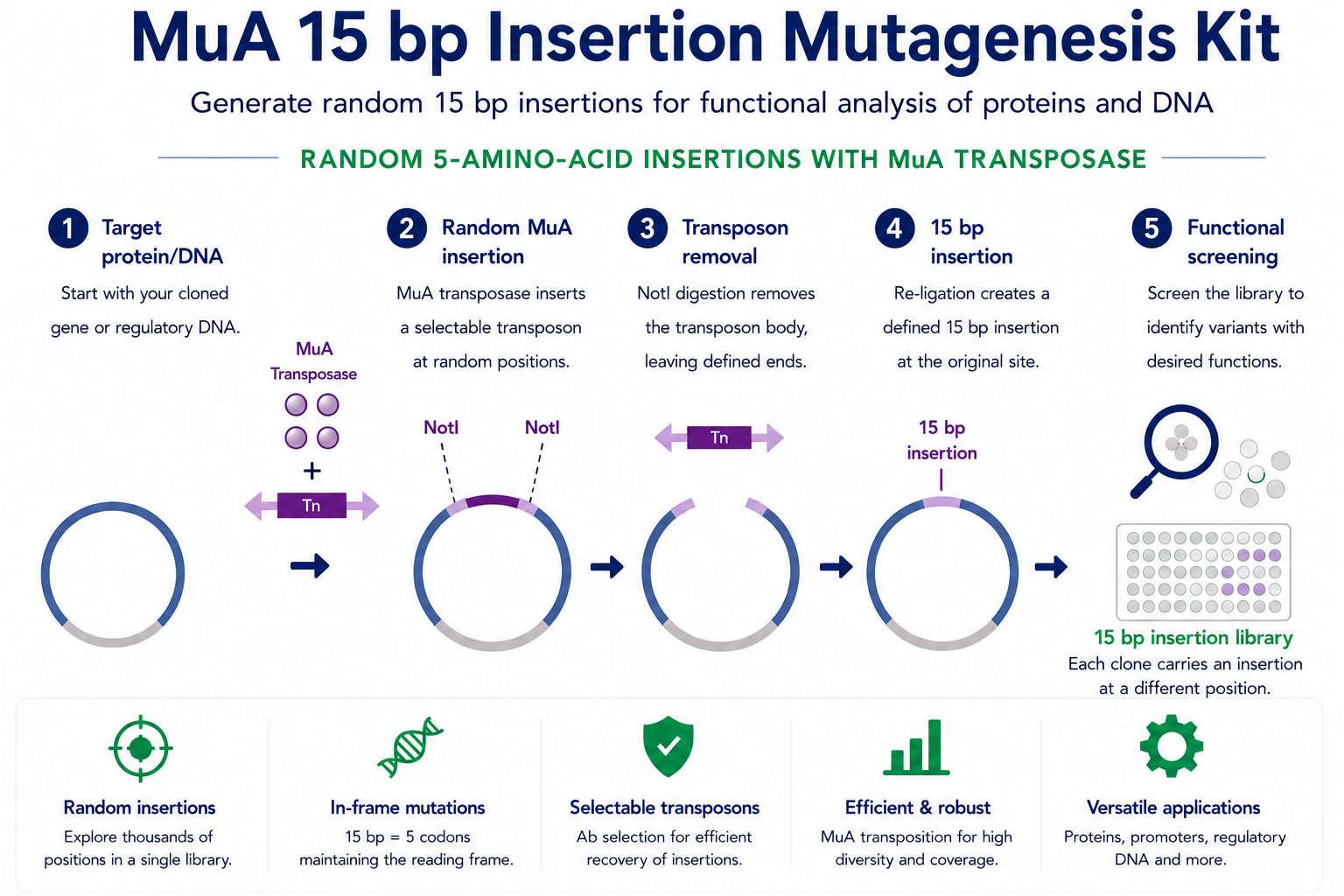
Figure 1 (click to enlarge). Schematic workflow of the Domus v.2 MuA 15 bp Insertion Mutagenesis Kit. MuA transposase introduces a selectable transposon at random positions in target DNA. Following selection, NotI digestion removes the transposon body and re-ligation generates a defined 15 bp insertion for functional screening.
Important Target DNA Considerations
The method is designed for cloned target DNA.
For the standard workflow:
- the target plasmid should not contain a NotI site (it would interfere with the transposon removal)
- the target plasmid should not carry the same selectable resistance marker as the transposon
- high-efficiency transformation (preferably electroporation) is recommended for the straightforward generation of comprehensive mutant libraries with a desired number of member clones
- MuA insertions can occur both within the DNA sequence of interest and within the vector backbone
If required, the DNA region containing the insertion library can be transferred into a fresh vector backbone prior to generating the final 15 bp library.
Find Functional Regions Without Mutating One Position at a Time
Instead of designing tens or hundreds of individual mutations, use MuA transposition to generate a diverse insertion library in a single workflow.
One target. Thousands of possible insertion positions. One library to screen.
VIRAL APPLICATIONS
Viral Genome Mutagenesis & Functional Mapping
Explore viral genomes with random 15 bp insertions
MuA-mediated 15 bp insertion mutagenesis is a powerful approach for systematic functional analysis of viral genomes. Large libraries of random, defined insertions can be generated throughout a cloned viral genome or selected genomic region, and subjected to functional selection or screening.
Following MuA-mediated transposition and removal of the transposon, a defined 15 bp insertion remains at the integration site. The insertion consists of transposon-derived sequence together with the 5 bp target-site duplication generated during MuA transposition. Importantly, the resulting insertion does not introduce a stop codon.
When an insertion occurs within a protein-coding region, the reading frame is maintained and five additional amino acids are introduced without deleting the original amino acids. This makes 15 bp insertion mutagenesis particularly useful for probing the structural and functional flexibility of viral proteins.
The approach has been applied to a diverse range of viral systems and can be used to investigate both genetic constraints and genetic flexibility across viral genomes.
What Can 15 bp Insertion Mutagenesis Reveal?
Random 15 bp insertion libraries provide a systematic approach for exploring, which regions of a viral genome are functionally important and which can tolerate additional sequence.
By generating insertions throughout a cloned viral genome and screening the resulting library, researchers can identify:
- functionally important genomic regions
- insertion-tolerant regions in viral proteins
- protein domains and linker regions that tolerate additional amino acids
- regions associated with viral replication or propagation
- potential sites for protein tags, reporters, or other engineered sequences
This makes 15 bp insertion mutagenesis a useful tool for both viral functional genomics and the identification of sites for downstream viral genome and protein engineering.
From Functional Mapping to Viral Genome Engineering
One of the particularly useful outcomes of insertion mutagenesis is the identification of sites that tolerate an additional sequence without eliminating viral function.
These insertion-tolerant positions can provide experimentally identified starting points for further viral genome engineering. Rather than choosing potential insertion sites solely from sequence or structural predictions, a large random library can be screened first to identify positions that are compatible with viral function.
Such sites may subsequently be explored for applications including protein tagging, reporter-virus development and insertion of other heterologous sequences.
In this way, MuA 15 bp insertion mutagenesis can bridge genome-wide functional mapping and targeted viral genome engineering.
Published Applications
The Mu-based 15 bp insertion strategy has been applied to both RNA and DNA viruses, demonstrating its versatility for viral functional genomics.
Together, these studies demonstrate applications ranging from genome-wide functional mapping and identification of replication-critical regions to protein-domain analysis, identification of insertion-tolerant sites, and viral genome engineering.
| Virus | Virus type | Reference |
| Potato virus A (PVA) | +ssRNA | Kekarainen et al. (2002). Functional Genomics on Potato Virus A: Virus Genome-Wide Map of Sites Essential for Virus Propagation. Genome Research 12(4):584–594. |
| Hepatitis C virus (HCV) | +ssRNA | Arumugaswami et al. (2008). High-Resolution Functional Profiling of Hepatitis C Virus Genome. PLoS Pathogens 4(10):e1000182. |
| Murine gammaherpesvirus 68 (MHV-68) | dsDNA | Arumugaswami et al. (2009). High-Resolution Functional Profiling of a Gammaherpesvirus RTA Locus in the Context of the Viral Genome. Journal of Virology 83(4):1811–1822. |
| Herpes simplex virus 1 (HSV-1) | dsDNA | Beilstein et al. (2009). Mutational Analysis of the Herpes Simplex Virus Type 1 DNA Packaging Protein UL33. Journal of Virology 83(17):8938–8945. |
| Venezuelan equine encephalitis virus (VEEV) | +ssRNA | Beitzel et al. (2010). High-Resolution Functional Mapping of the Venezuelan Equine Encephalitis Virus Genome by Insertional Mutagenesis and Massively Parallel Sequencing. PLoS Pathogens 6(10):e1001146. |
| Poliovirus | +ssRNA | Teterina et al. (2011). Identification of tolerated insertion sites in poliovirus non-structural proteins. Virology 409(1):1–11. |
| Influenza A virus | Segmented −ssRNA | Heaton et al. (2013). Genome-wide mutagenesis of influenza virus reveals unique plasticity of the hemagglutinin and NS1 proteins. Proceedings of the National Academy of Sciences USA 110(50):20248–20253. |
| Influenza A virus – polymerase | Segmented −ssRNA | Wang et al. (2016). Functional Genomics Reveals Linkers Critical for Influenza Virus Polymerase. Journal of Virology 90(6):2938–2947. |
| Dengue virus 2 (DENV-2) | +ssRNA | Eyre et al. (2017). Genome-Wide Mutagenesis of Dengue Virus Reveals Plasticity of the NS1 Protein and Enables Generation of Infectious Tagged Reporter Viruses. Journal of Virology 91(23):e01455-17. |
| Dengue virus | +ssRNA | Perry et al. (2018). Functional Analysis of the Dengue Virus Genome Using an Insertional Mutagenesis Screen. Journal of Virology 92(7):e02085-17. |
| Sendai, mumps & Newcastle disease viruses | −ssRNA | Ikegame et al. (2020). Genome-wide transposon mutagenesis of paramyxoviruses reveals constraints on genomic plasticity. PLoS Pathogens 16(10):e1008877. |
| Varicella-zoster virus (VZV) | dsDNA | Visalli et al. (2024). Mutagenesis and functional analysis of the varicella-zoster virus portal protein. Journal of Virology 98(4):e00603-23. |
Need Help Designing Your Insertion Library?
The optimal library strategy depends on your target size, vector, selectable markers, and downstream screening method.
Domus scientists can help you plan the experiment and determine the most suitable workflow for your target.
References
1. Haapa S, Taira S, Heikkinen E, Savilahti H. An efficient and accurate integration of mini-Mu transposons in vitro: a general methodology for functional genetic analysis and molecular biology applications. Nucleic Acids Research. 1999;27(13):2777–2784.
2. Kekarainen T, Savilahti H, Valkonen JPT. Functional Genomics on Potato Virus A: Virus Genome-Wide Map of Sites Essential for Virus Propagation. Genome Research. 2002;12(4):584–594.
3. Poussu E, Vihinen M, Paulin L, Savilahti H. Probing the alpha-complementing domain of E. coli beta-galactosidase with use of an insertional pentapeptide mutagenesis strategy based on Mu in vitro DNA transposition. Proteins. 2004;54(4):681–692.
4. Rasila TS, Pulkkinen E, Kiljunen S, Haapa-Paananen S, Pajunen MI, Salminen A, Paulin L, Vihinen M, Rice PA, Savilahti H. Mu transpososome activity-profiling yields hyperactive MuA variants for highly efficient genetic and genome engineering. Nucleic Acids Research. 2018;46(9):4649–4661.